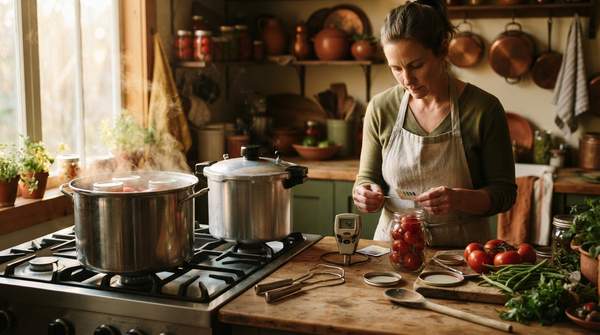
The single factor that determines whether you safely preserve food in a water bath canner or a pressure canner is acidity. High-acid foods—those with a pH of 4.6 or lower—can be processed in boiling water at 212°F. Low-acid foods—those with a pH above 4.6—must be processed in a pressure canner, which reaches 240–250°F, because only those higher temperatures destroy the spores of Clostridium botulinum, the bacterium that causes deadly botulism. South Dakota State University Extension puts the rule plainly: the technique you use depends on the acidity of the food, with water bathing for high-acid foods and pressure canning for low-acid ones.
Understanding the Core Principle: Acidity Dictates Canning Method
Both canning methods preserve food the same fundamental way: heat processing destroys microorganisms, and the sealed jar prevents new ones from entering. What separates the two methods is not the goal but the temperature each can achieve, and which foods need that extra heat. Acidity, measured as pH, is the dividing line.
Acidity can be natural or added. Most fruits are naturally acidic. Pickled foods get their acidity from added vinegar. As SDSU Extension explains, low-acid canned foods contain too little acid to prevent the growth of C. botulinum, while high-acid foods contain enough acid to block its growth or destroy the organism more rapidly when heated. That is why the same vegetable can shift categories: green beans alone are low-acid and need a pressure canner, but pickled green beans, acidified with vinegar, may be processed in a water bath using a tested recipe.
The threshold to remember is 4.6. At a pH of 4.6 or lower, the food's own acidity works as a safety barrier. Above 4.6, that barrier disappears, and heat alone must do the work of making the food shelf-stable.
The Science of Safety: Why pH Matters for Botulism Prevention
Clostridium botulinum is the reason the acidity rule exists. Its spores are common in soil and can ride along on vegetables, and they are remarkably tough. In a low-acid environment—inside a jar of beans, meat, or soup at room temperature—those spores can survive, germinate, and produce the toxin that causes botulism, a potentially fatal illness. The sealed, airless jar that protects your food from spoilage also happens to be an environment where this anaerobic organism can thrive if the spores were not destroyed during processing.
Here is the catch: boiling water cannot destroy these spores. A water bath canner tops out at 212°F, the boiling point of water, and that temperature is simply not high enough to eliminate C. botulinum in low-acid food. The Old Farmer's Almanac's canning guide, authored by Catherine Boeckmann, states that pressure canning is the only safe way to preserve low-acid foods to eliminate the harmful bacterium.
A pressure canner solves the problem with physics. By trapping steam under pressure, it raises the internal temperature to 240–250°F, hot enough to destroy botulinum spores. In high-acid foods, you do not need that extreme heat, because the acidity itself prevents the spores from growing and producing toxin, while boiling-water temperatures handle the spoilage organisms like mold and yeast.