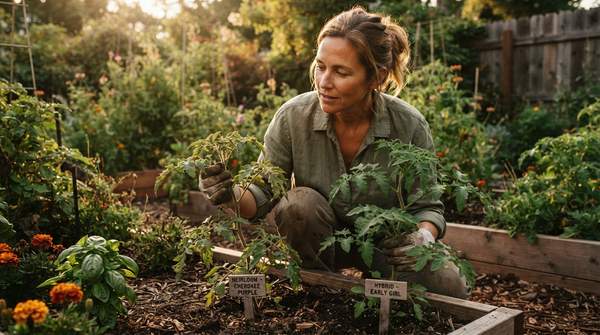
Heirloom vegetables earn their place in a garden with flavor, story, and seed you can save and replanted year after year—but they ask more of you in return. Compared with modern hybrids, they are typically much less resistant to common diseases and pests, they need more careful management of water and seeding depth, and their storage shelf life is normally shorter. The right choice depends less on which is "better" than on what you want from your garden: a predictable, easy harvest, or a living piece of culinary heritage on your plate.
Heirloom vs. Hybrid: Understanding the Core Differences
An heirloom seed comes from a historic plant cultivar passed down among generations of communities or families, as seed seller Jeff Bentley explains in his guide to heirloom seeds. Its defining characteristic is open pollination: the plants that produced it were pollinated naturally—by insects, birds, or wind—rather than through controlled crossing in a lab. Because the plants are genetically diverse, they can adapt over time to local climate and growing conditions.
Hybrid seeds are the result of cross-pollination between two distinct parent plants, deliberately combined to bring out chosen traits. Extension horticulturists Bob Westerfield, Whitney Richardson, and Makenzie English, writing for the University of Georgia's College of Agricultural and Environmental Sciences, note that hybrid varieties have been developed to improve resistance and other qualities that make them easier to grow. The catch is what can be lost along the way: in the hybridization process, flavor and some of the unique characteristics of a vegetable may disappear. That trade-off is the heart of the decision.
The Enduring Value of Heirloom Vegetables: Flavor, Heritage, and Biodiversity
Why do gardeners keep growing heirlooms when hybrids are easier? Flavor is the biggest reason, according to the UGA extension authors: the distinctive taste and character that can be sacrificed in hybridization survive intact in heirloom varieties. But taste is only part of the pull.
Many heirloom varieties are tied to specific ethnic groups or regions, serving as a living link to culinary heritage. 'Hopi Red' corn, for instance, is a staple in Native American traditions. When you grow an heirloom, you are participating in a chain of cultivation that predates modern seed catalogs.
That chain is actively tended. Seed Savers Exchange, a nonprofit founded in 1975 that helped pioneer the heirloom seed movement, now cares for a collection of more than 20,000 seed varieties. Its focus is unusual among seed banks: before accepting a seed donation, the organization learns the seed's history of being grown, saved, and shared, and why it is special. Because heirloom seeds are open-pollinated, a home gardener who saves them can replant true-to-type seeds year after year—preserving genetic diversity and culinary heritage in a single backyard act.