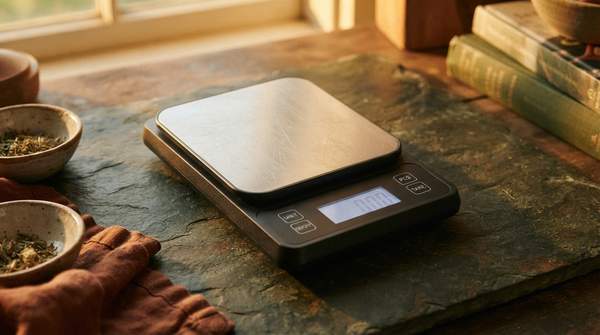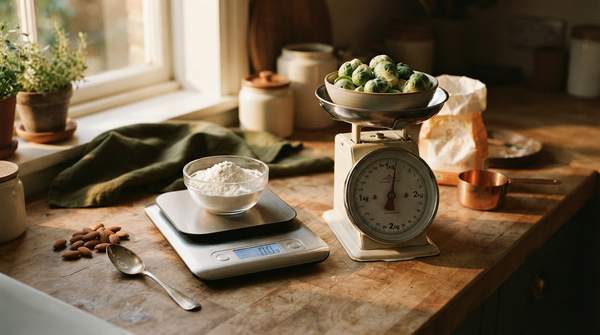
For most home cooks, a digital kitchen scale is the better choice: it measures to the nearest gram or ounce, offers an easy-to-read display, and includes a tare function that lets you weigh multiple ingredients in one bowl. An analog scale earns its place when you value simplicity, durability, and battery-free operation over exact measurements. The right answer depends on what you cook, and this guide maps that decision to your actual tasks.
Digital vs. Analog: Understanding the Core Differences
The core distinction is the technology inside. According to a comparison published by KitchenSupply, analog scales work on a spring mechanism, while digital scales rely on electronic sensors. That single difference drives nearly everything else: digital scales deliver the most accurate measurements and have become the most popular option, while analog scales are sturdier and tend to endure longer, because digital sensors can wear down and become unresponsive over time.
Practically, this means the two tools behave differently in your hands. A digital scale shows a number on a screen; an analog scale moves a needle across a dial. Neither is wrong—the choice comes down to whether you want precision and features, or economy and longevity. As the same comparison puts it, analog scales are often less expensive and can last "for the next 20 years," while digital scales are the more accurate and useful option for most kitchens.
Precision and Accuracy: What Your Recipes Demand
Cooking is an art, but baking is a precise science. As appliance maker AENO's usage guide explains, delicate recipes like soufflés, macarons, and artisan breads can change noticeably in texture, taste, and appearance from even a small measurement error—one reason a cup of flour can weigh anywhere from 120 to 150 grams depending on how it is scooped.
Digital scales measure to the nearest gram or ounce, and some compact models read in increments as fine as 0.1 grams, according to Bon Appétit's test kitchen coverage—though those small pocket-style scales typically have limited capacity, suiting tasks like weighing coffee more than large baking projects. Analog scales are generally less precise, limited by the physical dial and spring mechanism, and reading them accurately depends on your visual interpretation of where the needle sits.
Why does this matter? Consumer Reports, whose experts test food scales, puts it plainly: if you are not perfectly packing flour or baking soda into a measuring cup, being off by an ounce can affect the taste and appearance of cakes, muffins, and cookies. The numbers on a scale, by contrast, do not lie—if a lemon cake calls for 285 grams of flour, that is the exact number your scale should read.
Essential Features: Tare Function and Unit Conversion
The tare function is the feature that changes how you cook. It resets the displayed weight to zero, which lets you subtract the weight of your bowl and then add ingredients one at a time without emptying it. AENO's guide describes the workflow for baking a cake: set the bowl on the scale, hit the tare button to reset the weight to zero, and add each ingredient—flour, sugar, cocoa powder—by weight, one after another. You skip the pile of measuring cups, and cleanup shrinks accordingly.
Most modern digital scales also include unit conversion, letting you switch between grams and ounces at the touch of a button—useful when a recipe is written in metric and your intuition is not. Analog scales typically offer only basic weighing; some older or simpler models have a manual zero adjustment, but not a true tare. That means with an analog scale, you generally weigh ingredients separately or do the container-weight arithmetic yourself.
Durability, Power, and Maintenance
Here the trade-off reverses. Digital scales require batteries or charging, and their electronic components can be sensitive to moisture or impact; battery life varies by model, and some handle water exposure better than others. Analog scales need no batteries at all, are sturdy and long-lasting, and can often accommodate heavier weights, according to AENO's pros-and-cons comparison.
Think about your kitchen realistically. If your scale will live in a drawer, get tossed into a picnic basket, or survive near a busy sink, an analog model's mechanical simplicity is a genuine advantage—there is no circuitry to fail. If your scale will sit on the counter next to your stand mixer, plugged into your baking routine, the digital scale's battery requirement is a minor cost for its precision.
Decision Framework: Choosing Your Kitchen Scale
The table below categorizes common kitchen tasks by their precision and feature needs, then maps those needs to the documented strengths and weaknesses of each scale type. Read down the task column to find what you actually do in your kitchen.
| Task | Precision Needed | Key Feature | Recommended Type |
|---|---|---|---|
| Delicate baking (soufflés, macarons, artisan breads, cakes) | High—grams matter; a cup of flour can vary by 30 grams | Tare for multi-ingredient bowls | Digital |
| Coffee making | High—some digital scales read to 0.1 grams | Fine increments, easy display | Digital |
| Calorie and macronutrient tracking | High—exact portions matter | Clear readout, tare | Digital |
| General portioning (weighing chicken, vegetables, meal prep) | Moderate—approximate weights are fine | None required | Either; analog suits simple use |
| Heavy, rough, or battery-free use | Moderate | Sturdy mechanical build | Analog |
The pattern is consistent: the more a task depends on exact weights, the more the digital scale's precision and tare function pay off. The more a task depends on the scale simply surviving, the more the analog scale's spring mechanism and battery-free design recommend themselves.
Making the Right Choice for Your Kitchen
Choose a digital kitchen scale for tasks requiring high precision, such as baking, coffee preparation, or calorie tracking, and an analog scale for general-purpose weighing where durability and simplicity are prioritized over exact measurements. Pastry chef Briana Holt, speaking to Wirecutter, captured why this decision matters: "Accuracy is one of the keys to feeling empowered when baking at home." Her advice for home cooks is to find a scale and look for recipes written in weights.
The measurable indicator is the consistency and quality of your culinary results, particularly in baking, which will improve when using the appropriate scale type for the task. Bake the same recipe twice with a scale suited to it, and watch whether your results repeat—same crumb, same rise, same texture. That repeatability is the proof you chose correctly.
Sources
- Digital vs Analog Scales: How Do They Weigh Up? (11 Differences) — KitchenSupply
- Should I Buy a Food Scale, and How to Use Kitchen Scale? – AENO Blog
- This Kitchen Scale Has Been With Our Senior Test Kitchen Editor for Over a Decade — Bon Appétit
- 4 Best Food Scales, Tested by Our Experts - Consumer Reports