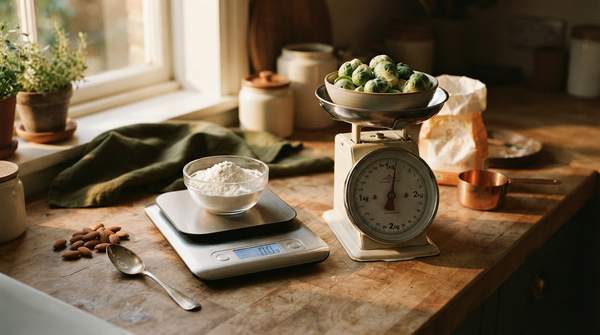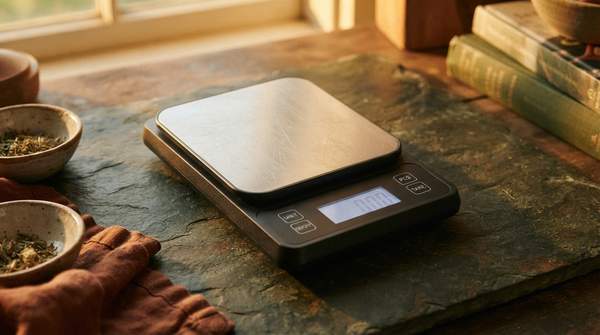
For most home cooks—especially bakers—a digital kitchen scale is the better choice. It measures to the nearest gram or ounce, converts between units at the touch of a button, and offers a tare function that makes multi-ingredient recipes far easier. Analog (mechanical) scales still have a place, though: they need no batteries, tolerate rough handling, and can handle heavier loads. The real question isn't which type is "best," but which precision and features your cooking actually demands.
Digital vs. Analog Kitchen Scales: An Overview
The two scale types work on completely different principles. A digital scale uses an internal control board and sensor chips to measure weight electronically, running on batteries or an outlet. A mechanical scale relies on a series of springs that compress under load and move a dial. That single difference in technology explains nearly everything else: how precisely each scale reads, what features it can offer, and how it behaves over years of use.
Spring-based scales have a practical weakness beyond their coarser readouts. As AENO's kitchen scale guide notes, analog models "may lose accuracy over time," and you need to check the dial carefully to avoid miscalculations. Digital scales, by contrast, are described by the same guide as "extremely accurate, easy to read," though they depend on a power source and can be sensitive to spills. BestReviews, writing for The Morning Call, adds that digital models typically have a slim, compact design that stows away easily, even in small kitchens.
Digital vs. Analog Kitchen Scales: A Comparative Table
| Attribute | Digital Scale | Analog (Mechanical) Scale |
|---|---|---|
| Technology | Internal control board and electronic sensor chips; needs batteries or an outlet | A series of springs; no external power required |
| Typical precision | Nearest gram or ounce; some models read in 0.1-gram increments | Coarser increments—some models measure in steps as large as 50 grams (about 2 ounces) |
| Key features | Unit conversion (grams, ounces, kilograms, pounds), tare function, backlit digital display | Basic weight measurement only; typically no tare or unit conversion |
| Power source | Batteries or electrical outlet | None needed |
| Best for | Baking, coffee brewing, portion control, and meal prep where exact amounts matter | Large-batch weighing that doesn't require precision, and situations where durability and battery-free operation matter |
| Primary drawbacks | Requires power; some models can't support heavy weights; sensitive to spills | Too imprecise for baking and other exact measurements; accuracy can drift over time |
Read the table with your own habits in mind. If you recognize yourself in the "best for" column for digital scales, the drawbacks are usually manageable inconveniences. If you recognize yourself in the analog column, the precision loss may never affect your results.