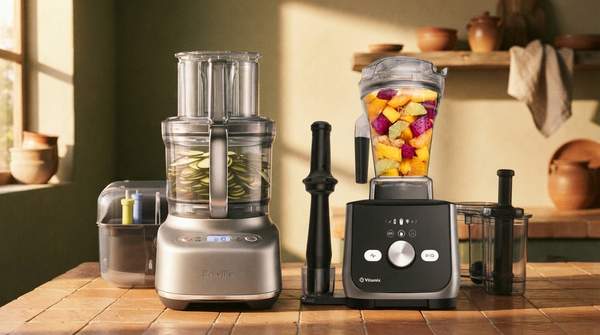
The short answer: choose a blender when you want silky, liquid-smooth results, and choose a food processor when you want chunky, evenly chopped, shredded, or mixed results. The reason is mechanical, not magical. A blender's tall, narrow jar and single fixed blade create a vortex that pulls wet ingredients down into the blades, while a food processor's wide work bowl and interchangeable blades and discs handle solids with precision. Once you understand those two design differences, picking the right tool for any recipe becomes almost automatic.
Introduction: Choosing Your Kitchen Workhorse
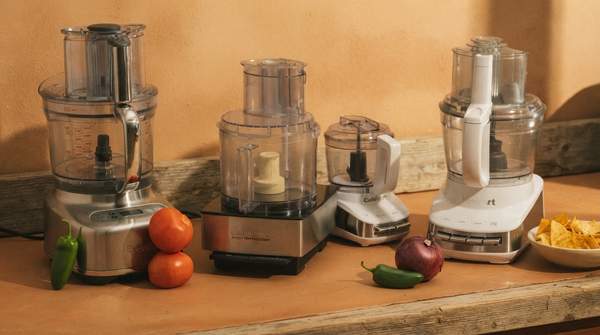
Both appliances sit on a motor base and do the same fundamental job—breaking down food—but they are built for opposite outcomes. As KitchenAid's comparison guide explains, blenders usually have one blade and tall jars and are typically used for wetter recipes, while food processors usually have multiple blades and wide work bowls and can shred and slice in addition to pureeing.
That distinction matters because texture is the whole point of these machines. A silky coulis and a rustic tabbouleh both require cutting food into small pieces, but the size and uniformity of those pieces are completely different. Bon Appétit's Mark Marino makes the same point with a simple test: want peanut butter? Food processor. A batch of baby food? Blender. Neither tool is better overall—each is better for a specific job, and the design tells you which.
Blenders: Mastering Smoothness and Liquids
The blender's defining feature is its fixed blade, usually a single unit at the bottom of the jar that cannot be switched out. That sounds like a limitation, but it is exactly what makes the blender so good at its specialty. Because the blade never changes, the entire machine is optimized around one motion: spinning fast enough to liquefy whatever crosses its path.
The jar does the other half of the work. According to KitchenAid, the blender's tall, narrow jar creates a vortex that draws ingredients downward toward the blades, continuously folding contents back into the cutting zone. This is why blenders handle wetter recipes so well—liquids flow, circulate, and get pulled back through the blades until nothing lumpy remains. Some blenders also provide higher power compared to food processors, enabling faster blade rotation that breaks down tough ingredients for smoother results.
So when your goal is a uniform, fine texture—liquid recipes or silky smooth results like a coulis—the blender is your tool. Baby food is another classic blender task, and KitchenAid notes it can be made in a blender, especially with specific attachments.