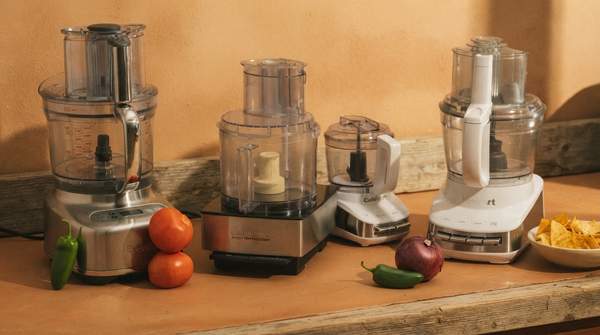
The answer comes down to three questions: what tasks you do most often, how much food you prepare at once, and how many people you cook for. Manufacturer guidance groups home food processors into three practical categories—small (1–4 cups), medium (5–9 cups), and large (10+ cups)—and each category maps cleanly to a distinct set of kitchen habits. Before you browse brands or models, decide your category first. That single decision narrows your search and prevents the two most common mistakes: buying a mini chopper that can't handle family dinners, or buying a 14-cup machine that hogs the counter for occasional herb chopping.
Understanding Food Processor Sizes: Mini, Compact, and Full-Size
Food processor sizes refer to the amount of food the bowl can hold, and the labels vary somewhat between manufacturers. Breville's buying guide defines small as 1–4 cups, medium as 5–9 cups, and large as 10 cups or more. KitchenAid's guide frames residential machines slightly differently, noting that home food processors range from around 6–16 cups and, depending on capacity and functionality, can do everything from mixing and puréeing to kneading and dicing.
Those overlapping definitions matter because a "compact" model from one maker may sit in the same capacity band as a "full-size" model from another. The three-category framework—small, medium, large—smooths out the marketing language and gives you a stable way to compare. What stays consistent across both manufacturers is the logic: as bowl capacity grows, the range of tasks the machine can handle grows with it.
Small machines earn their keep on quick, small jobs. Breville notes they can do the work of several miscellaneous kitchen tools without tough-to-clean attachments, but they have one major limitation: they can only handle so much. If you want to chop ingredients for a big family dinner, you'll need a bigger size. Medium machines, meanwhile, are where most standard at-home processors fall, offering enhanced prep capabilities while still occupying a modest corner of your kitchen.
Food Processor Size Comparison: Find Your Perfect Match
Use this table to cross-reference your typical tasks and household size. Find the row that matches both, and you've found your category. Where manufacturers define the bands slightly differently, the ranges below follow Breville's small/medium/large framework, with task detail drawn from both Breville's and KitchenAid's guides.
| Size Category | Bowl Capacity | Best For (Tasks & Ingredients) | Ideal Household Size |
|---|---|---|---|
| Small (mini) | 1–4 cups | Chopping herbs and nuts, dressings, sauces, dips, single servings and small batches | Individuals or couples |
| Medium (compact) | 5–9 cups | Everyday cooking: chopping, slicing, shredding, puréeing, meal-prep quantities | Small to medium households (2–4 people) |
| Large (full-size) | 10+ cups | Bulk food prep, batch cooking, kneading dough, dicing large quantities, cooking for gatherings | Larger families and frequent hosts |
The reasoning behind the table is straightforward. Small bowls physically cannot hold enough volume for family-scale prep, so they suit single servings and small batches—Breville's guidance is explicit on this point. Medium bowls hit the versatile middle ground: enough capacity for everyday meals, modest enough for counter and storage space. Large bowls exist for volume, and KitchenAid's guide ties the bigger capacities directly to bulk prep, batch cooking, and dough work.
One practical note on the boundaries: if your cooking straddles two rows—say, you cook for two but bake bread weekly—size up to the larger category, because a too-small bowl is a hard physical limit while a slightly-too-large bowl is merely an inconvenience.