The single most effective long-term step a home vegetable gardener can take is adding the right kind of organic matter. On clayey soils, Colorado State University Extension explains, amendments improve aggregation, increase porosity and permeability, and improve aeration, drainage, and rooting depth; on sandy soils, they increase water and nutrient holding capacity. The key word is "right kind": the amendment that opens up heavy clay differs from the one that helps sand hold onto water, because each material works through a distinct physical and biological mechanism. Understanding those mechanisms turns guesswork into a decision.
Understanding Your Soil: Clay vs. Sandy
Both extremes challenge gardeners in opposite ways. Loam soils, as Colorado State's guidance describes, are a mixture of different particle sizes, and most gardens fall short of that ideal.
Clay soil's problem is structural: its tiny particles pack tightly, restricting the pore space that roots, water, and air depend on. Sandy soil's problem is retention. As Bootstrap Farmer's guide explains, sandy soils have a small particle size and an inability to hold much moisture, making it hard for them to hold onto small plant roots as well. Sand typically shows up in coastal regions, near forests and deserts, and along riverbanks, with a gritty texture.
Each problem calls for a different functional solution. As Colorado State's soil amendment guidance puts it: with sandy soils, the goal is to increase the soil's ability to hold moisture and store nutrients; with clay soils, the goal is to improve aggregation, porosity, permeability, aeration, and drainage.
The Power of Organic Matter: Core Mechanisms
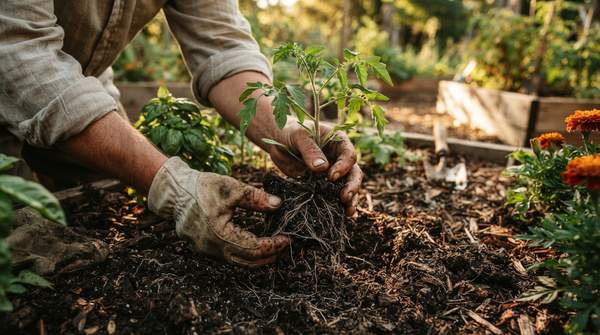
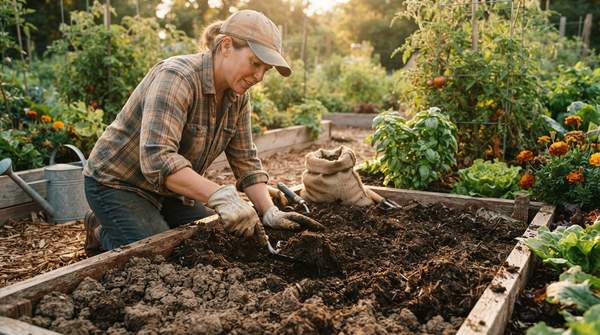
Why does organic matter help both extremes? On clayey soil, it works slowly and physically. Colorado State's vegetable garden guidance describes how organic matter, over a period of years, glues tiny soil particles together into larger aggregates, increasing pore space. That aggregation is what loosens compacted clay from the inside out.
In sandy soil, the mechanism flips: decomposing organic matter acts as a sponge-like reservoir, raising the soil's capacity to hold both moisture and the nutrients that would otherwise wash away past the root zone.
Organic matter also feeds soil life. The Almanac's soil preparation guide lists what it improves: drainage and aeration in heavy clay, water retention in sandy soils, soil structure and workability, slow-release nutrients and microbial activity, and soil pH balance. Those benefits compound—better structure lets roots deepen, and active microbes release nutrients plants can use.
Compost and Aged Manure: Building Blocks for Soil Health
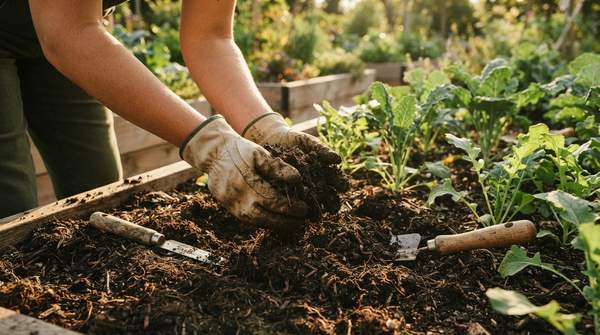
Compost—decomposed organic matter, whether plant- or animal-based—is the general-purpose workhorse. Emily Gaines, writing for Bootstrap Farmer, credits it with improving soil over time, reducing erosion, improving water drainage and retention, boosting nutrient availability by increasing cation exchange capacity, and increasing crop yields.
But not all compost is created equal. Gaines warns that compost can be overly high in salt, and that when poorly made it can pass along weed seeds, jumping worms, and soil-borne diseases—so gardeners should source a high-quality, safe product.
Aged manure is richer in nutrients, and the Almanac's guidance is blunt: manure should be composted only—fresh manure or unfinished compost can be high in ammonia and, out of pathogen caution, should be applied well ahead of planting (at least four months before harvest). Well-decomposed materials like compost and aged manure are Colorado State's recommended choice when the goal is moisture and nutrient storage.
Cover Crops: Living Amendments for Long-Term Improvement
Cover crops and green manures take a different route: instead of hauling in material, you grow it. According to Colorado State's vegetable garden guidance, green manure crops are grown in between vegetable seasons—winter crops in some areas, summer heat crops in hot southern regions—though they are less practical where the entire growing season is devoted to vegetables, as in Colorado.
Roots do much of the work. Oregon State University's Extension guide on improving garden soils notes that the mat of roots formed by a cover crop is often more valuable for building soil structure than the plants above ground. Bootstrap Farmer adds that green manures—crops like mustards grown to plow under—increase organic matter and improve soil structure, break pest cycles, and prevent erosion.
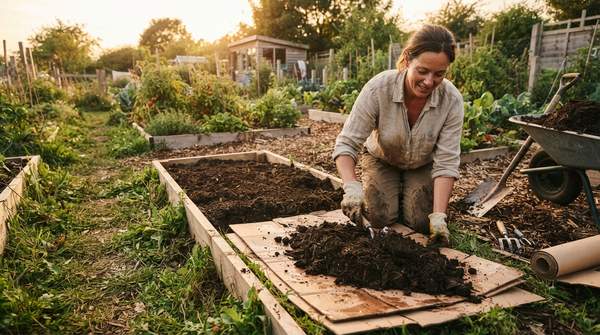
Timing matters. Oregon State recommends digging in the cover crop at least two weeks before planting the garden, or removing the above-ground portion and composting it. A no-dig alternative—applying a layer of organic amendment on the surface and planting into it—avoids work and soil disturbance and mulches to conserve moisture and suppress weeds, but is slower to raise soil organic matter content.
Wood Products: Considerations for Soil Amendment
Fibrous materials—peat, wood chips, tree bark, or straw—are Colorado State's most effective choice for clay soils precisely because their coarse, lasting structure helps keep aggregated clay particles apart and pores open.
But wood products carry a trade-off. They raise organic matter while decomposing, and that decomposition draws on the soil's nitrogen. The mitigation, per the same guidance, is adding extra nitrogen fertilizer when incorporating wood products, so the microbes breaking them down don't out-compete vegetables for the nitrogen they need.
One caution worth repeating from the same source: amendments are not regulated like fertilizers and can be high in salts, so choices should be informed by site conditions, landscape goals, and soil test results rather than applied universally.
Decision Framework: Choosing Your Soil Amendment
The framework below is built from Colorado State's matching logic—well-decomposed amendments for sandy soils' retention problem, fibrous amendments for clay's aggregation problem—combined with the mechanism evidence from the other sources. To use it, identify your soil's primary limitation, then read across to the amendment whose mechanism addresses that limitation directly.
| Soil Type / Problem | Recommended Amendment | Mechanism of Action | Key Qualification |
|---|---|---|---|
| Heavy, compacted clay | Fibrous materials (wood chips, tree bark, straw, peat); well-decomposed organic matter over time | Organic matter glues tiny clay particles into larger aggregates, increasing pore space, aeration, drainage, and rooting depth | Aggregation builds "over a period of years"—expect gradual improvement, not instant loosening |
| Sandy soil that dries out quickly | Well-decomposed amendments: compost, aged manure, peat; tilled-in cover crop debris | Raises the soil's ability to hold moisture and store nutrients so water and nutrients stay in the root zone | Test soil often—sandy soil tends not to hold nutrients, so re-amend as needed |
| Low nutrient availability | Compost or aged (composted) manure | Supplies nutrients released slowly as material breaks down; beneficial soil organisms and microbial activity feed the cycle | Use composted manure only; fresh manure or unfinished compost can be high in ammonia—apply at least four months before harvest |
| Compacted or eroding ground between crops | Cover crops / green manures | Root mat builds soil structure; biomass tilled in adds organic matter and improves water and nutrient holding capacity | Dig in at least two weeks before planting; less practical where the whole season is needed for vegetables |
| Clay needing volume and long-lasting structure | Wood products (chips, bark, sawdust) | Fibrous, slow-to-decompose material keeps clay aggregates separated and pores open | Can temporarily deplete soil nitrogen as microbes break it down—add extra nitrogen fertilizer at incorporation |
Reading the matrix, a pattern emerges: decomposition stage is the deciding variable. Well-rotted material suits sand, where you want a sponge; fibrous, slow-rotting material suits clay, where you want spacing. Cover crops supply both root structure and decomposable biomass, but they cost you a growing window.
Application rates vary by product and region, so consult product labels or your local extension service, and this article deliberately omits inorganic amendments like perlite and vermiculite, compost-pile construction instructions, and contaminated-soil remediation—separate topics entirely.
Cultivating Healthier Soil for Bountiful Harvests
Regularly assess your garden soil's structure and nutrient needs, then apply the most appropriate organic amendment based on its specific mechanism of action: fibrous, slow-decomposing material for tight clay; well-rotted compost or aged manure for thirsty sand; cover crops when a growing window allows; extra nitrogen whenever wood products go in.
The measurable indicator that this is working, per the extension guidance underlying these mechanisms, is improved plant vigor, better water infiltration and retention, and reduced soil compaction over successive growing seasons. Watch how water moves after rain, how roots meet the spade, and how your vegetables grow—the soil will tell you when its problem has finally met its matching amendment.
Sources
- Choosing a Soil Amendment — Colorado State University Office of Engagement and Extension
- A Beginner's Guide to the Best Soil Amendments for Healthier Gardens — Bootstrap Farmer
- Vegetable Gardens: Soil Management and Fertilization — Colorado State University Office of Engagement and Extension
- How to Prepare Your Garden Soil for Planting — Almanac.com
- Improving garden soils with organic matter — OSU Extension Service