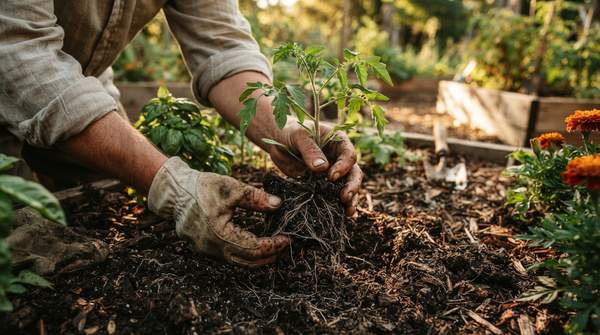
For most home gardeners, the answer is no: mycorrhizal fungi are already present in most healthy soils, and Oklahoma State University's extension service notes plainly that "it might not be necessary to purchase mycorrhizae." The money-saving path is to protect and feed the fungi already living beneath your feet. Commercial inoculants earn their price mainly in narrow situations — sterile potting mixes, brand-new beds, or soil that has been intensively managed — where native fungal populations are likely depleted or absent.
The Hidden Helpers: Understanding Mycorrhizal Fungi
Mycorrhizal fungi are soil organisms that form a symbiotic partnership with plant roots, trading their underground labor for the sugars plants produce above ground. The fungi thread through the soil far beyond the reach of a root itself, extending the plant's effective foraging territory in exchange for carbon from photosynthesis. This is not a new invention waiting on a store shelf; the system has been developing for hundreds of millions of years, and the fungal populations are, as the Soil Project Network's guidance puts it, "already present" in most gardens. All a gardener has to do is encourage their growth and health.
That framing matters for your wallet. If the partnership is already in place in your soil, the question shifts from "what should I buy?" to "what am I doing that helps or harms it?" Oklahoma State University's fact sheet on mycorrhizal fungi confirms these organisms occur naturally in most soils, which is why the decision to purchase is genuinely situational rather than routine.
Three Key Benefits for Your Garden Plants
The first benefit is resource uptake. Colonized roots gain access to more water and more nutrients than they could reach alone, which supports stronger growth and, in the extension's reporting, increased crop yield with enhanced flowering. The fungal network effectively widens the plant's shopping radius in the soil.
The second is stress tolerance. Oklahoma State lists increased drought and salinity stress tolerance among the reported benefits of the symbiosis — a meaningful advantage in dry summers or marginal soils. Higher transplanting success is another documented benefit, which is why the moment of planting features so prominently in the decision framework below.
The third is protection. The extension reports increased pathogen resistance as a benefit of mycorrhizal colonization, alongside improved soil structure. In other words, a healthy fungal network is not just a fertilizer substitute; it is part of the garden's immune system and its physical architecture, binding soil particles into a structure that holds water and resists erosion.