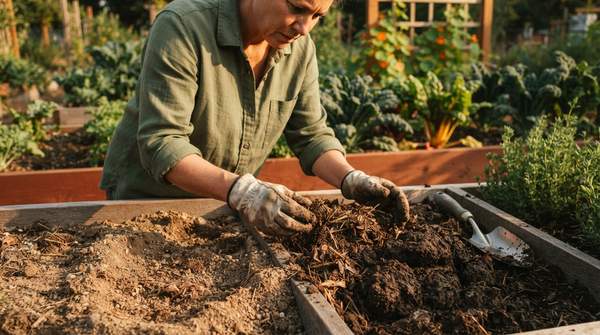
Every vegetable garden problem with soil structure comes down to one of two opposite failures: sandy soil drains so fast that water and nutrients slip away before roots can use them, while clay soil holds water so tightly that roots suffocate and beds turn to muck. The fix in both cases is organic matter, but the right type differs. For sandy soil, Colorado State University Extension recommends well-decomposed materials—compost, peat, aged manure—that add moisture and nutrient storage. For clay, the same source points to fibrous materials such as peat, wood chips, tree bark, or straw that open up the soil's structure so air and water can move through it.
Understanding Your Soil: Sandy vs. Clay
Loam, the soil most gardeners aspire to, is simply a balanced mixture of different particle sizes. Sandy soils sit at one extreme: their large particles leave wide gaps that let water drain rapidly, so the soil struggles to hold both moisture and the nutrients dissolved in it. Clay sits at the other: its fine particles pack tightly together, trapping water and leaving too little pore space for the air that roots need. As CSU Extension puts it, both sandy soils and clay soils are a challenge for gardeners—but in mirror-image ways.
You can often diagnose your own situation without a laboratory. Soil that drains within minutes of a rain, feels gritty, and dries into loose grains is behaving like sand; the plants in it wilt quickly between waterings. Soil that stays puddled for a day after rain, forms a sticky ball when squeezed wet, and bakes into a hard crust is behaving like clay; seedlings struggle in it and beds stay waterlogged in spring.
That said, a formal soil test is still worth getting before you buy anything. One reason is practical: application rates for any amendment should follow your test results and product labels, and a test also tells you whether nutrient levels or pH—not texture—are actually limiting your vegetables. The diagnosis of texture simply tells you which category of amendment to shop for.