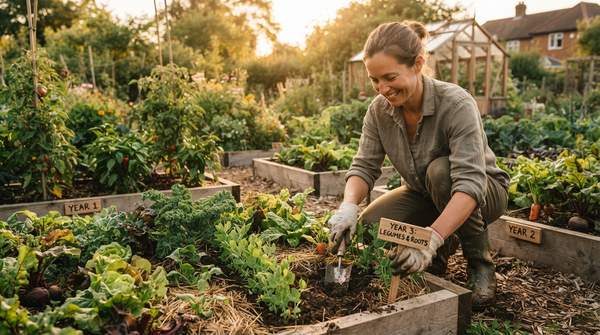
Crop rotation works on a simple, powerful principle: don't plant the same vegetable family in the same spot year after year. When you move families of crops between beds annually, you starve soil-borne pests and diseases of their host plants, and you spread nutrient demands across your soil instead of draining it in one place. The practical payoff for a home gardener is a garden that needs less pest control, suffers fewer lingering diseases, and holds its fertility across seasons. Here is how to group your vegetables by botanical family and turn that grouping into a workable multi-year plan.
Key Plant Families for Rotation Planning
The first mistake most new planners make is rotating by individual vegetable. Swapping tomatoes for potatoes is not a rotation at all, as one gardening guide puts it plainly: both are nightshades, and they share the same vulnerabilities, including blight and the Colorado potato beetle. Rotation is organized by botanical family because relatives share pests, diseases, and appetites—what one nightshade depletes or attracts, its cousins do too.
Horticultural extension guidance echoes this. Vegetables in the same botanical family tend to draw the same type and amount of nutrients from the soil, which is why Aaron Steil, writing for Iowa State University's Yard and Garden program, notes that members of the gourd family use a lot of nitrogen while the onion family takes up a greater share of potassium than other plants. The pests follow family lines just as closely. The Royal Horticultural Society advises that rotation helps avoid diseases such as clubroot in brassicas and onion white rot, because pest populations tend to decline in the period when their host plants are absent.
For a home garden, five families cover most of what you are likely to grow: the nightshades, brassicas, legumes, cucurbits, and alliums. A few crops stand alone—corn, okra, and sweet potatoes belong to families with only one common garden member—but they can be slotted into your rotation as their own small groups. Keep in mind one firm exception: perennial vegetables and herbs should not be moved yearly, since they stay in the ground year-round. This guide is for annual vegetables in a home garden setting, not perennials or fruit trees.
Your Home Garden Crop Rotation Planning Chart
Use the chart below as your planning reference. It groups common garden vegetables by botanical family, classifies each family's nutrient demands, and lists the soil-borne pests and diseases most associated with each group. The reasoning is straightforward: families that share nutrient appetites and share vulnerabilities should travel together through your beds, so that heavy feeders alternate with lighter feeders and nitrogen givers, and susceptible families stay away from ground that recently hosted their particular troubles.
| Vegetable Family | Common Examples | Nutrient Demand | Common Pests / Diseases |
|---|---|---|---|
| Nightshades (Solanaceae) | Tomatoes, potatoes, peppers, eggplant | Heavy feeders | Blight, verticillium wilt, Colorado potato beetles |
| Brassicas (Brassicaceae) | Cabbage-family crops | Heavy feeders | Clubroot, cabbage worms |
| Cucurbits (Cucurbitaceae) | Zucchini, summer and winter squash, cucumbers, pumpkins, melons, gourds | Heavy feeders; grow best in rich soil and use a lot of nitrogen | Not family-specific in supplied guidance |
| Legumes (Fabaceae) | Beans | Givers—add nitrogen to the soil | Not family-specific in supplied guidance |
| Alliums (Amaryllidaceae) | Onions | Draw more heavily on potassium than other families | Onion white rot |
Read the chart horizontally to see each family's character, and vertically to design your sequence. Heavy feeders—nightshades, brassicas, and cucurbits—remove large amounts of nutrients from the soil, so they should follow, not precede, another heavy-feeding family. Legumes are the counterweight: because beans add nitrogen to the soil, they replenish what the heavy feeders took. The Royal Horticultural Society singles out clubroot and onion white rot as diseases rotation demonstrably helps avoid, which is why keeping brassicas and alliums moving matters more than keeping lettuce moving.
In a small garden, you can simplify by combining families into larger groups—grouping brassicas with legumes and lettuce makes rotations easier, one Almanac guide suggests. The chart is general guidance; specific pest and disease pressure varies with local conditions, so treat the vulnerabilities column as a starting point, not a regional forecast.