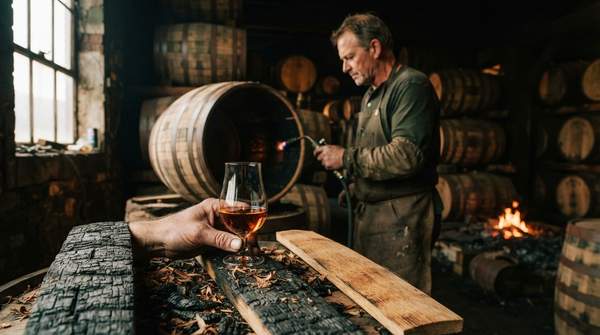
Every vanilla note in your bourbon and every whisper of spice in your brandy begins as chemistry inside a barrel. Two variables do most of the work: the species of oak the barrel is made from, and how fiercely its interior was burned before filling. American oak tends toward sweetness, vanilla, and caramel; French oak leans toward spice, complexity, and tannic grip. Light char preserves toasted sweetness, while heavy char pushes a spirit toward smoke and richness. Understanding these two levers turns a confusing label into a reliable prediction of what a bottle will taste like.
Additive and Subtractive Processes: How Barrels Refine Spirits
Barrel aging is often imagined as a one-way street: wood lends flavor, spirit receives it. The reality is more elegant. As trade publication Beverage Master describes it, maturation inside a barrel is "both an additive and subtractive process." The additive side is the wood giving of itself—charring and the wood's own composition release tannins and lignins into the alcohol, compounds that carry color, structure, and flavor.
The subtractive side is quieter but just as important. As the spirit matures, some of its less desirable components simply evaporate away through the wood. The char layer plays a filtering role too: barrel supplier Midwest Barrel Co. explains that as liquid absorbs into the wood, the char filters out certain compounds from the spirit—including congeners, byproducts of fermentation responsible for harsh, off-putting flavors that distillers would rather not reach the bottle.
A scientific review of wood-aged beverages published in PMC adds a third dimension: during aging, volatile components are intensified through water evaporation, gradual compound release from the wood matrix, and the formation of new esters. The result is a beverage whose tannins, lactones, and phenolic compounds settle into what the review calls "a refined sensory balance." In other words, a barrel does not merely season a spirit—it edits it, concentrates it, and lets it harmonize.
Wood Type Matters: American vs. French Oak
Oak is oak, a shopper might assume—but the species changes the story. The two most common woods in traditional spirit aging are American and French oak, and they behave differently in the glass. According to beverage distributor Horizon Beverage, American oak gives a liquor a fuller, oaky flavor with a sweeter profile and hints of vanilla or caramel. French oak, by contrast, produces a more complex flavor with hints of spice, and spirits aged in it tend to carry more tannins.
Distillery Hush and Whisper offers a vivid framing: distilleries choose their casks "like artists choose paint, each type of wood brings its own personality." American white oak, the backbone of bourbon and most American whiskey, has a tight grain that holds liquid securely while still allowing controlled oxidation, and its barrels impart caramel, vanilla, and faint coconut character. The underlying chemistry supports the sensory difference: oak wood is naturally rich in tannins, lignins, lactones, and vanillin, and the proportions of these compounds vary between species, which is why the same spirit can taste sweeter in one oak and spicier in another.