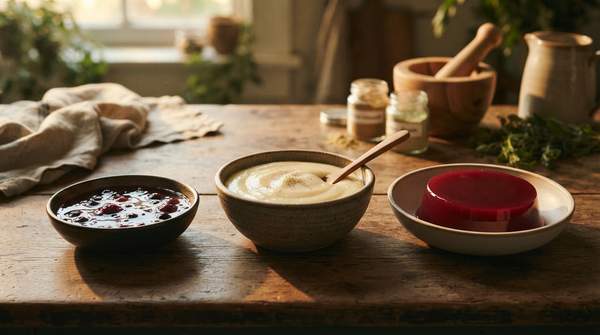
Every plant-based thickener has a personality. Cornstarch makes smooth, glossy, opaque sauces but can turn spongy or thin if you freeze it or boil it too long. Arrowroot, a root starch cultivated for thousands of years in the Caribbean, thickens without clouding a dish's color or sheen and holds up through freezing. Agar, drawn from seaweed, does something the starches cannot: it sets into a firm gel at room temperature. Matching the thickener to the finished texture you want—clear versus opaque, creamy versus sliceable, freezer-bound versus fresh—is the whole game.
Plant-Based Thickeners at a Glance: A Comparative Table
The table below sorts the three most common plant-based thickeners by the job each does best, the texture and appearance it produces, and the handling detail that most often makes or breaks the dish. Read down the "Best For" column first to find your recipe's goal, then check the handling tip before you head to the stove.
| Thickener | Best For (Application) | Resulting Texture & Appearance | Key Handling Tip |
|---|---|---|---|
| Arrowroot | Clear sauces and glazes; dishes that will be frozen; gluten-free baked goods | Clear, glossy, smooth; similar to cornstarch-thickened sauces; slightly gritty in baked goods | Mix into a slurry before adding to hot liquid; avoid over-heating, which thins the mixture |
| Cornstarch | Opaque sauces, gravies, stir-fries, and creamy puddings | Smooth, glossy, opaque | Whisk into a slurry, bring to a low boil briefly to activate; avoid prolonged boiling and freezing |
| Agar | Firm, sliceable gels, puddings, and gelatin-free desserts | Firm gel that sets without refrigeration | Use sparingly—its setting strength exceeds gelatin's, so less is needed |
Arrowroot: For Clear, Glossy, and Freeze-Stable Dishes
When a sauce should sparkle—think fruit glazes and pan sauces where you want the liquid's own color to shine through—arrowroot is the root starch that delivers. The Vegetarian Journal notes that arrowroot-based sauces behave much like cornstarch-thickened mixtures in body, with one crucial difference: as the hot liquid thickens, it turns clear rather than cloudy. Writing for Escoffier Online, Sarah Larson points to the same virtue, recommending it for vegan dishes precisely because it thickens "without changing the color or sheen of the dish."
Two cautions govern arrowroot's use. The Vegetarian Journal warns that if the mixture is overstirred and heated too long, it thins again—so add your slurry near the end of cooking and stir gently. In baking, arrowroot contributes a texture similar to wheat flour in muffins and cookies and can help bind gluten-free flours, though it retains a slightly gritty character (less so than rice flour). Its clarity and freeze-stability make it the natural choice for make-ahead sauces and fillings destined for the freezer.