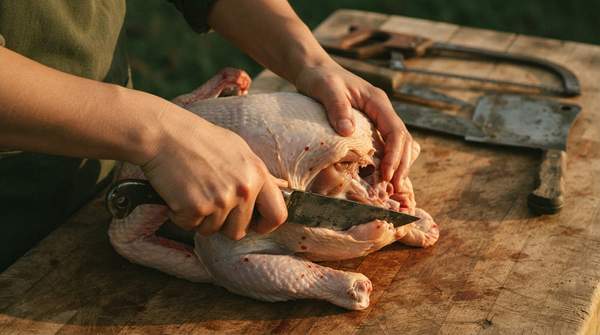
Yes, you can break down a whole chicken at home with one sharp knife, a cutting board, and a little patience — and the payoff is more than thrift. Jacqueline, a chef writing for the Chicago cooking school The Chopping Block, argues that the store-bought cut-up bird is missing its most valuable part: the back, which she calls "an essential ingredient in chicken stock." The core technique, repeated for every appendage, is simple: gently pull the part away from the body, slice through the skin, pop the joint, and then slice through it. This guide covers a basic eight-piece breakdown of a store-bought whole chicken — no deboning, no Frenching, no slaughter or plucking — and maps each finished cut to its best culinary use.
Tools for Whole Chicken Butchery
You need very little equipment, but sharpness is non-negotiable. The Chopping Block's method calls for a very sharp 10-inch chef's knife as the workhorse, supplemented by kitchen shears (poultry shears if you have them), a large cutting board, a sheet tray or bowl to hold the cut pieces, and paper towels. A very sharp boning knife — or even a small paring knife — is recommended, not required, for working close to joints. A dull knife is the real hazard here: it slides, it crushes, and it forces you to press harder than the delicate joints warrant.
Before any cutting, rinse the chicken inside and out and pat it dry with paper towels. A dry bird is easier to grip, and a firm grip is what lets you feel the anatomy. The single most useful skill in this whole process is tactile: take your time and feel around the bird until, as Jacqueline puts it, you know "its every nook and cranny." Joints reveal themselves to your fingers before they reveal themselves to your eyes.
Step-by-Step Guide to Breaking Down a Whole Chicken
Start with the chicken breast-side up on your cutting board. The sequence below yields the classic eight pieces — two drumsticks, two thighs, two wings, two breast halves — plus the backbone for stock.
- Remove the legs. Cut through the skin and flesh around the joint where the leg meets the body, then bend the leg back until the joint pops and cut cleanly through it. Repeat on the other side.
- Separate thigh from drumstick. Find the fat line between the two and cut through the joint there. You now have four leg pieces.
- Remove the wings. Pull each wing away from the body to expose the joint, then cut through it. The pull-slice-pop-slice rhythm is identical to the legs.
- Separate the back from the breast. Turn the chicken breast-side down and cut along both sides of the backbone. Set the backbone aside — this is your stock piece.
- Split the breast. Cut through the breastbone to yield two breast halves.
Notice that the steps repeat themselves, whether you are removing thighs, wings, drumettes, or legs — the method is always the same, and Jacqueline promises it becomes quick and easy with practice. Her reasoning for learning the skill is practical: working with whole fowl and larger cuts of meat will save you money and, in her experience, vastly improve your cooking skills and confidence. If a cut resists, you are likely on bone rather than in the joint; back the blade out and re-feel for the gap.
Cut-to-Cuisine Decision Framework
Butchering is only half the value of a whole bird; the other half is knowing what each cut does best. Butchers and poultry sellers consistently sort chicken parts into two working categories: lean white meat that cooks fast and dark meat whose higher fat content rewards slower, moister methods. Use this table the moment your bird is in pieces — it turns one chicken into several distinct meal components rather than a pile of interchangeable parts.
| Cut | Character | Best cooking methods |
|---|---|---|
| Breast halves | Lean white meat | Oven baking, grilling, poaching, or sautéing |
| Thighs | Dark meat, higher fat, stays moist and flavorful | Oven baking, grilling, sautéing, slow cooking, braising, or frying |
| Drumsticks | Dark meat on the bone | Slow, moist methods like braising and slow cooking; also bake or grill |
| Wings | Flavorful mix of dark meat and fat that renders when cooked | Oven baking, grilling, or deep frying; natural appetizer cut |
| Back/carcass | Bone and connective tissue | Stock, broth, and soups — or simmered into boxed stock to deepen flavor and add viscosity |
The back deserves special emphasis because it is the piece commercial cut-up chickens lack. Owton's, a British butcher, describes chicken back as "an often overlooked cut" that is "a real gem for adding depth of flavour," ideal for rich stocks and broths thanks to its bone and connective tissue. Jacqueline's trick is equally useful: even if you never make stock from scratch, simmering a piece of the back in boxed stock adds what she calls real chicken flavor and, more importantly, viscosity, giving soup or sauce a luxurious mouth feel.
On the meat side, the fat content drives the decision. Thighs, with their higher fat content, remain moist under the long, slow, or high-heat methods that would dry out a breast — which is why braising, slow cooking, and frying suit them. Wings, which Owton's calls one of the most flavorful parts of the bird, owe their appeal to a mix of dark meat and a fat layer that renders beautifully, creating a crispy, succulent bite when baked, grilled, or deep fried. Breasts, the leanest cut, are best matched to quick, controlled methods: baking, grilling, poaching, or sautéing.
Confidently Utilize Every Part of Your Chicken
By following the step-by-step butchering guide and using the Cut-to-Cuisine framework, home cooks can confidently break down a whole chicken and plan meals to utilize all parts effectively. Keep the boundary in mind: this is a basic eight-piece breakdown, the starting point is a store-bought cleaned bird, and the table suggests cooking methods rather than full recipes. Your measurable indicator of success is concrete: the home cook successfully prepares multiple dishes from a single whole chicken — say, poached breasts one night, braised thighs and drumsticks the next, and a back-simmered stock after that — demonstrating reduced food waste and increased culinary versatility. When your knife finds the joints without hesitation and the backbone ends up in the pot rather than the trash, the whole bird has done its whole job.