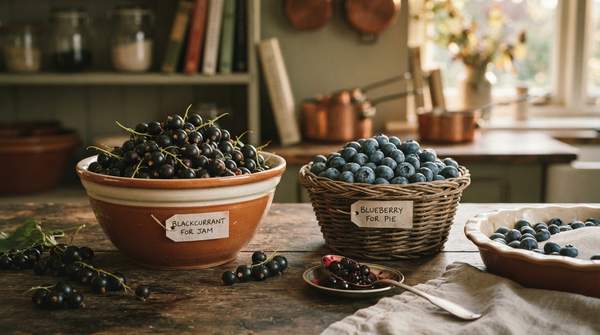
The berry you reach for should depend on the job you're giving it. A jam needs pectin and acid to set; a pie needs fruit that holds its shape; a bowl for fresh eating needs full ripeness and sweetness. Match those three demands against a berry's natural chemistry, and the choice almost makes itself.
Consider the numbers. Blackcurrants (pH 2.8) and gooseberries (pH 2.9) sit on the acidic, high-pectin end of the fruit spectrum, according to the sugar, acid, and pectin reference data compiled by pastry writer Fanny Zanotti. Blueberries (pH 3.2), strawberries (pH 3.4), and raspberries (pH 3.4) all fall into the low-pectin camp, while blackberries land in the middle (pH 4.2, medium pectin). Those figures are the backbone of every recommendation that follows.
Understanding Berry Basics: Pectin and Acidity
Jam is applied food science. As the jam-making guidance from Penseberry Farm explains, a proper set needs three things working together: fruit, sugar, and acid. Pectin, a natural fiber in fruit, is what creates the gelled texture people expect from a finished jam. Recipes can lean on added commercial pectin, but berries that bring enough natural pectin and acidity of their own are simply easier to work with, and they tend to taste more balanced too.
Acidity and pectin are separate dials. Pectin determines whether a jam will firm up; acid shapes the flavor and, in practice, makes preserving straightforward. A berry can be pleasantly tart but low in pectin — raspberries are a classic case — which means it delivers brightness in the jar while still needing help to set. Reading the two properties together, rather than assuming tart fruit equals good jam fruit, is the first skill of berry selection.
Ripeness complicates things further. Fully ripe fruit has the strongest flavor, but slightly underripe berries usually contain more pectin, Penseberry Farm notes. That's a genuine trade-off: your sweetest, most aromatic fruit may be the weakest setter in the batch.
Berry Selection Matrix for Culinary Projects
Here is the comparison at a glance, built from Zanotti's fruit data and HelloFresh's guidance on berry structure and cooking behavior. Lower pH means more tart fruit.
| Berry | Pectin level | Average pH | Tartness | Best use |
|---|---|---|---|---|
| Blackcurrant | High | 2.8 | Very tart | Jam that sets easily |
| Gooseberry | High | 2.9 | Very tart | Jam that sets easily |
| Blueberry | Low | 3.2 | Moderately tart | Pies and baking |
| Strawberry | Low | 3.4 | Moderately tart | Fresh eating; jam with added pectin |
| Raspberry | Low | 3.4 | Moderately tart | Fresh eating; jam with added pectin |
| Blackberry | Medium | 4.2 | Mildest of the group | Pies and jam with modest pectin help |
The pattern is clear from the table: blackcurrants and gooseberries are the two berries that arrive with everything a jam needs, while strawberries and raspberries — beloved for flavor, not chemistry — sit at the bottom of the pectin scale. Their "moderately tart" label is an interpretation relative to the other fruits in the source data, not an official classification.